If you haven’t visited us in Zázrivá yet, you’ve surely heard about our little slice of paradise and our cabin, which we’re very proud of—even if it might not look all that great at first glance 😁
Those who’ve already been know this, and those coming for the first time will see what makes this place so magical (at least, we hope so, otherwise, we could’ve done without all this fuss!)
To help you get ready and give you a little background, we’ve decided to introduce you to Zázrivá (yes, we know how hard it is to find information these days, so we went digging through the “archives” for you…)
First, a little geography
The Zázrivá region consists of three mountain ranges and 11 inhabited valleys. The municipality is characterized by its “laz” (mountain hamlets with scattered settlements) – one of which is home to our famous little house. All of this contributes to Zázrivá’s unique character.
A brief look back
The village was founded on the estate of Orava Castle as a shepherds’ village, and the first written mention of Zázrivá dates back to 1556. At that time, according to census records, it had between 150 and 200 inhabitants. Starting in the spring, they would live for months with their herds in the mountains until winter set in. During the cold months, they would come down to what is now the village center. Gradually, families began to settle permanently where they spent the summer, thus giving rise to the current hamlets.
In the 1970s, Zázrivá was the largest municipality in Orava, with over 4,100 residents. Currently, the municipality has approximately 2,400 residents (as of 2025).
A long-standing French tradition in Zázrivá (it’s surely no coincidence!)
On October 3, 1909, at 3:00 p.m., the fourth edition of the “Gordon Bennett” hot-air balloon race began in the Swiss town of Schlieren. The next day, October 4, 1909, around 1:30 p.m., much to the surprise of the residents of Zázrivá who were plowing their potato fields, the hot-air balloon “Ile de France,” piloted by French aeronauts Alfred Leblanc and J. Delebeque, made an emergency landing in the area of Mount Kozinec. The cause was likely strong winds. After this forced landing, the aeronauts were thrown from the basket, and all their tools, weapons, and documents scattered across the ground. The balloon, now 130 kilograms lighter, rose again and disappeared into the clouds. The two pilots, helpless and completely defenseless, found themselves alone in the forest, wearing only hiking boots. The balloonists ultimately finished in second place after traveling more than 800 km.
A documentary filmed in a house located a few meters below the place of the wedding.
The Traditions of Zázrivá
Alpine livestock farming (salaš)
Pastoral sheep farming is a system of sheep rearing unique to the Carpathians. According to several sources, it is believed to have originated in the Balkan Peninsula and spread to the Carpathians. It is precisely this form of pastoral sheep farming that has shaped Zázrivá for centuries. In Slovakia, it adapted to local natural and social conditions and developed distinctive characteristics. Pastoral sheep farming was developed by the Vlachs, who settled in the mountainous regions of the Slovak Carpathians in the 15th century.
The high-mountain pastures were not suitable for raising other animals, and harvests were less abundant than in the fertile lowland regions. However, such an environment is perfectly suited to sheep. That is why sheep farming for wool, milk, and dairy products such as cheese, bryndza, and žinčica has developed in Zázrivá.
Traditionally, flocks of sheep remained in the mountain pastures with the shepherds from spring to fall, which required the construction of mountain pasture buildings to serve as shelters for the men, barns for milking the animals, and facilities for processing and storing the products. The sheepfold was led by a foreman, who divided the work among the shepherds and apprentices (the newcomers to the sheepfold). Since they lived much of the year on their own, this was reflected in their skill at crafting (but especially at aesthetically decorating) the tools they used:
- črpáky (containers for drinking whey),
- varechy (ladles),
- gelety (containers for storing and transporting bryndza, but also used for milking),
- decorated valašky (long axes used as walking sticks when grazing in rugged terrain, but also for splitting wood and protecting against bears and wolves), cheese molds and oštiepky molds
- musical instruments such as various whistles, bagpipes, and the fujara, which is also listed on the UNESCO World Heritage List.
It is not only traditional crafts and musical instruments that reflect the deep-rooted place of sheep farming in culture and folklore, but above all the dishes. Halušky with bryndza have become the Slovak national dish; oštiepky and parenice (smoked cheeses) are also very popular, as are bryndza (unsalted sheep’s milk cheese that is left to rest, then salted and rolled into balls), and žinčica (a fermented milk drink).
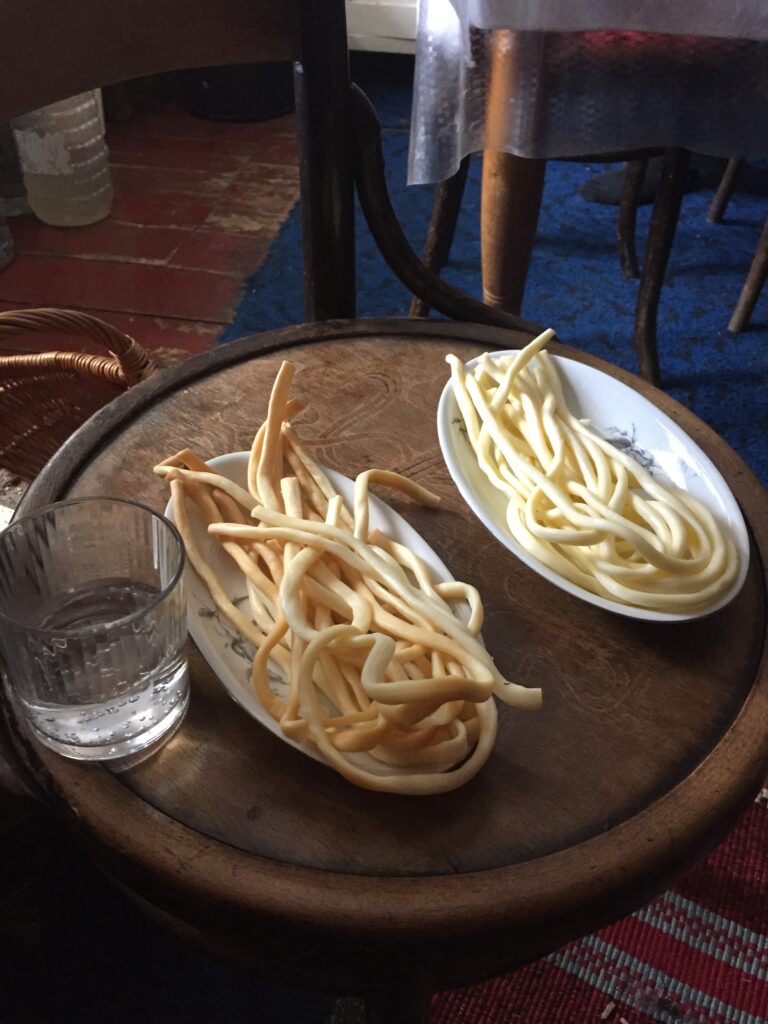
Korbáčiky (braided cheeses)
Some say that it was in Zázrivá, as early as the 19th century, that people began making the famous korbáčiky. According to legend, a shepherd began making them by accident in a mountain pasture after his grandson dropped some cheese into boiling water. At that time, the production and sale of cheese were the only source of income for the region’s herders. And to this day, no machine has been able to replace the skilled hands of the people of Zázrivá!
Korbáčiky are made by dipping cheese into hot water, then stretching it into strands (traditionally called “vojky”) before braiding them into a korbáčik. It is precisely the manual work involved in preparing the cooked dough -the kneading and stretching- that gives korbáčiky their unique and distinctive fibrous texture. YUM YUM 😋
No matter how hard they try, no French cheese can hold a candle to a good korbáčik from Zázrivá!
Folk art
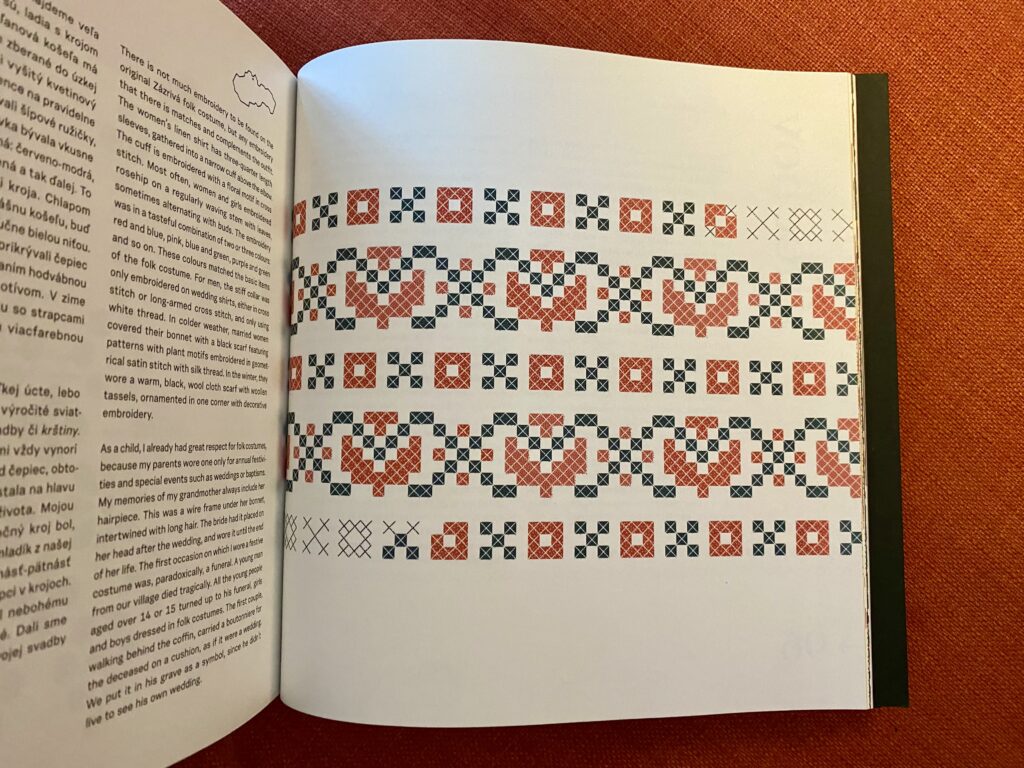
In addition to traditional wooden houses, the making of “korbáčiky,” folk songs and dances, and other traditions of folk art, Zázrivá has also distinguished itself for its clothing production (traditional costumes). As in all regions of Slovakia, the costumes and embroidery of Zázrivá had their own distinctive features. Tomáš Kompaník dedicated himself to mapping embroidery patterns from various regions of Slovakia in his book AHA100. It was precisely this book that inspired our design, which you’ll find throughout this website—and at the wedding!